Shaped by Hand, Fired by Tradition
The clay pottery villages keeping Mexico's oldest craft alive
At four in the morning on a Tuesday in San Miguel Tenextatiloyan, a small town in the Sierra Nororiental of Puebla, the tianguis is already awake. Vendors arrive with trucks loaded with cazuelas, ollas, jarros, and tiny three-centimeter miniatures that could sit on a child’s fingernail. Other stalls display person-sized cazuelas large enough to cook for a wedding. Money changes hands, but so do goods — barter, or trueque, is still practiced here, a pre-colonial economic habit that has simply never stopped being useful. In this town, whose Nahuatl name means “the place where they burn lime,” ninety-five percent of the population works in alfareria — the art of making pottery from clay. The town’s other name says it plainly: San Miguel de las Ollas.
This is not a museum exhibit. It is a Tuesday.
The production of traditional Mexican clay pottery begins, literally, underground. In San Miguel Tenextatiloyan, artisans extract raw earth from natural clay banks using picks and wheelbarrows. Three tonnes fill a single truck. A block of prepared clay, called a marqueta and weighing around twenty-five kilograms, will yield thirty-five to forty jarros. The full production cycle from raw earth to finished, decorated piece takes approximately twenty-five days.
That cycle used to take even longer. Until about ten years ago, the clay preparation alone — crushing, soaking, and kneading the raw material into a workable consistency — required fifteen to twenty days and was done with the help of burros, who trampled the clay to break it down. The introduction of a batidora, a mechanical mixing machine, compressed that stage to roughly twenty minutes. It is one of the few concessions these workshops have made to industrial technology.
The forming itself varies by community and tradition. In Boxasni, a community in Cadereyta, Queretaro — designated a Pueblo Magico — the tarraja technique uses molds to shape the vessels. One artisan named Damian keeps more than three hundred yeso molds in his workshop and exports finished pieces to Madagascar, Germany, and the United States. When asked what clay means to him, his answer is immediate: “Para mi el barro significa nobleza” — for me, clay means nobility.
In Oaxaca, the approach is more elemental. At a workshop in San Bartolo Coyotepec connected to Casa Wabi, the process is entirely by hand: five to ten minutes of kneading, then a fist driven into the center of the clay mass to hollow it out, walls shaped by hand pressure alone, followed by palmear — patting the surface to firm the walls. No wheel, no mold, no mechanical aid. The learning philosophy matches the method. “No hay otra manera de aprender mas que ensayar, hacerlo todos los dias,” one artisan explains — there is no other way to learn than to practice, to do it every day.
No hay otra manera de aprender mas que ensayar, hacerlo todos los dias — There is no other way to learn than to practice, to do it every day.
Two Fires
Every piece of traditional Mexican pottery passes through fire twice.
The first firing is called sancocho, the bisque stage. In San Miguel Tenextatiloyan, this means loading between one hundred fifty and two hundred pieces into a kiln, then feeding it with wood and bark for about two and a half hours, followed by an hour and a half of sawdust to sustain the temperature past a thousand degrees. The pieces emerge hardened but porous, a dull terracotta surface waiting for color.
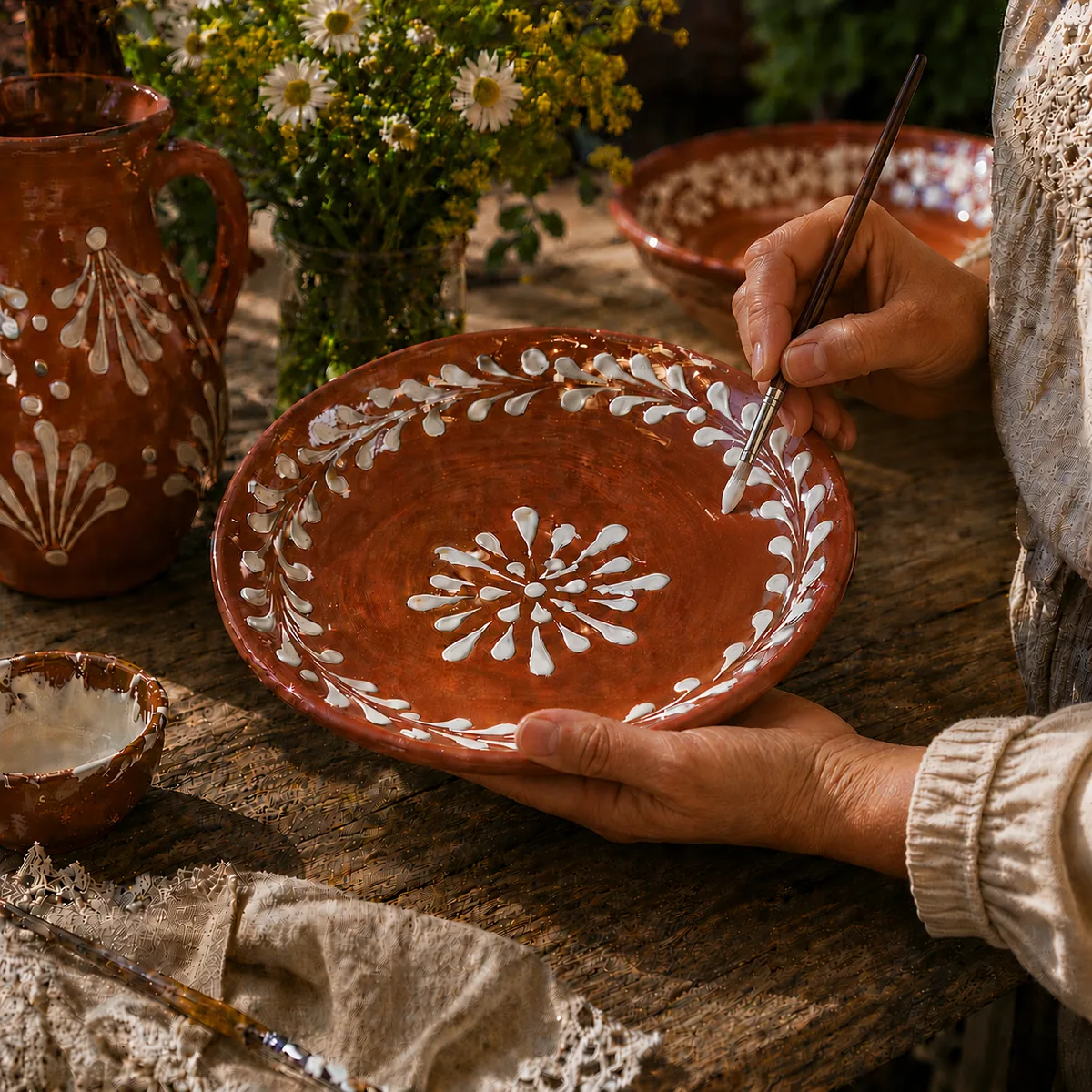
Then comes decoration, and this is where each workshop’s identity becomes visible. In San Miguel Tenextatiloyan, the ornament is done entirely freehand — no stencils, no molds, no templates. Carmelo Franco Garcia, a fourth-generation artisan, is known for developing techniques distinct from anyone else’s in the community. Each taller has its own visual signature, handed down and slowly modified across generations. As one artisan puts it, “Cada quien echa a volar su mente” — everyone lets their mind take flight. In Boxasni, painted details depict churches, pyramids, vegetation, and representative dolls.
After decoration, the piece enters the second firing: the vidriado, or glaze firing. Traditionally, this involved greta, a lead-based glaze that gave the pottery its characteristic shine and impermeability. For centuries, this was simply how it was done. The health consequences were understood much later.
The Lead Problem and the Women Who Solved It
In San Bartolo Cohuecan, in southwestern Puebla within sight of Popocatepetl, a quiet revolution has been unfolding. For generations, the lead-based glazes used in traditional pottery exposed artisan families — especially women, who often handled the glazing — to dangerous levels of lead. The effects accumulated in blood, in bones, in children who played on workshop floors. More than a thousand tests have been conducted since 2009 to track the problem.
A community-led transition to lead-free glazes, driven largely by the women artisans of the village, has produced measurable results: a fifty percent reduction in blood lead levels over seven years. Forty-two workshops have been certified as barro aprobado — approved clay — with another twenty-five on the waiting list. The lead-free glaze firing takes about five hours, compared to two hours for the bisque sancocho stage. The certification is not just a health achievement. It is a market differentiator, a way to signal to buyers that this pottery is both traditional and safe, that honoring the past does not require poisoning the present.
Eighty Potters and the Question of Fair Pay
Boxasni has roughly eighty potters working in about ten family-run workshops, carrying forward a tradition that stretches back more than two hundred years. In San Miguel Tenextatiloyan, the patron saint festival on September 29 — the feast of San Miguel Arcangel — draws the community together around the craft that defines it. Dona Mago, seventy-two years old and still working, states it with the clarity of someone who has spent a lifetime in the same trade: “Es nuestro fuente de trabajo” — it is our source of livelihood.
Across these communities, one message appears with increasing frequency and urgency: “No al regateo.” No to haggling. The phrase is a direct challenge to a deeply ingrained consumer habit in Mexican markets — bargaining down the price of handmade goods until the artisan is working for almost nothing. The argument is straightforward: a cazuela that took twenty-five days to produce, that was shaped by hand, fired twice, and painted without a template, should not be priced as though it rolled off a factory line. Fair pay is not charity. It is arithmetic.
A Living Craft, Not a Dying One
It would be easy to frame these stories as elegies — the last potters, the vanishing tradition, the inevitable march of plastic and mass production. But the evidence pushes back against that narrative. San Miguel Tenextatiloyan has ninety-five percent of its population engaged in pottery. Boxasni is exporting to three continents. San Bartolo Cohuecan is not only preserving its craft but making it safer, led by the women who know the workshop floor best. New techniques like the batidora and the tarraja coexist with freehand decoration and wood-fired kilns. The tradition is not frozen. It is adapting, on its own terms.
The next time you hold a clay jarro or cook in a cazuela de barro, consider the twenty-five days and the thousand-degree fires it survived to reach your hands. Consider the artisan who let their mind take flight while painting it. And when you are told the price, pay it.
Sources: arte-sano, Azteca Noticias, SIN RUTA, Casa Wabi