The Bag That Replaced the Basket
A mesh bag stitched on Calle Roldán, Mexico City — and its embroidered cousin in Chamula.
Step into any mercado in Mexico and you will see it — a mesh bag hanging from a wrist in line at the frutería, the weave stretched around whatever the day's errand has gathered. The bag is just over a hundred years old. Before it, women carried canastas — woven baskets. Then, sometime around the turn of the last century, the mesh bolsa de mandado arrived and quietly took the basket's place. As the artisans of Calle Roldán put it:
Esta bolsa vino a sustituir a las canastas, y porque la gente pues le gusta, estamos hablando más de 110 años de esta bolsa y sigue vigente.
This is the story of how that flat rectangle of malla becomes something a woman trusts to carry her week home from the market.
The Workshop on Calle Roldán
The taller sits on Calle Roldán, in the Centro Histórico of Mexico City, just past La Merced — one of the oldest commerce-and-supply houses for fiber bags in the capital. It was founded more than forty-three years ago by Don Raúl, who arrived in the city from Hidalgo as a small child. "Yo soy huérfano de mamá desde los 3 meses de edad," he says when he tells the story. "Tuvimos que venirnos a la Ciudad de México a luchar, a sobrevivir." Hunger and need brought him to the door of a fiber-bag workshop, where a woman he calls "muy conocida" — the necessity itself — first showed him the trade.
He did not know how to make a bag. A man named Don Pablo taught him. "Porque yo no sabía hacer una bolsa, él me enseñó," he says — and that one sentence is the whole lineage of the workshop. Today his son Raúl, the second generation, places the handles and drives the final rivets at the front of the shop. Around them work thirty-five costureras, stitching from their homes across the city. One of them, Eva, has been at her machine for more than three decades. "Esto para mí es la infancia," she says of the bags, which she has been making since girlhood.
Between them all, the workshop turns out around thirty thousand bags every fifteen to twenty days.
Cutting the Malla
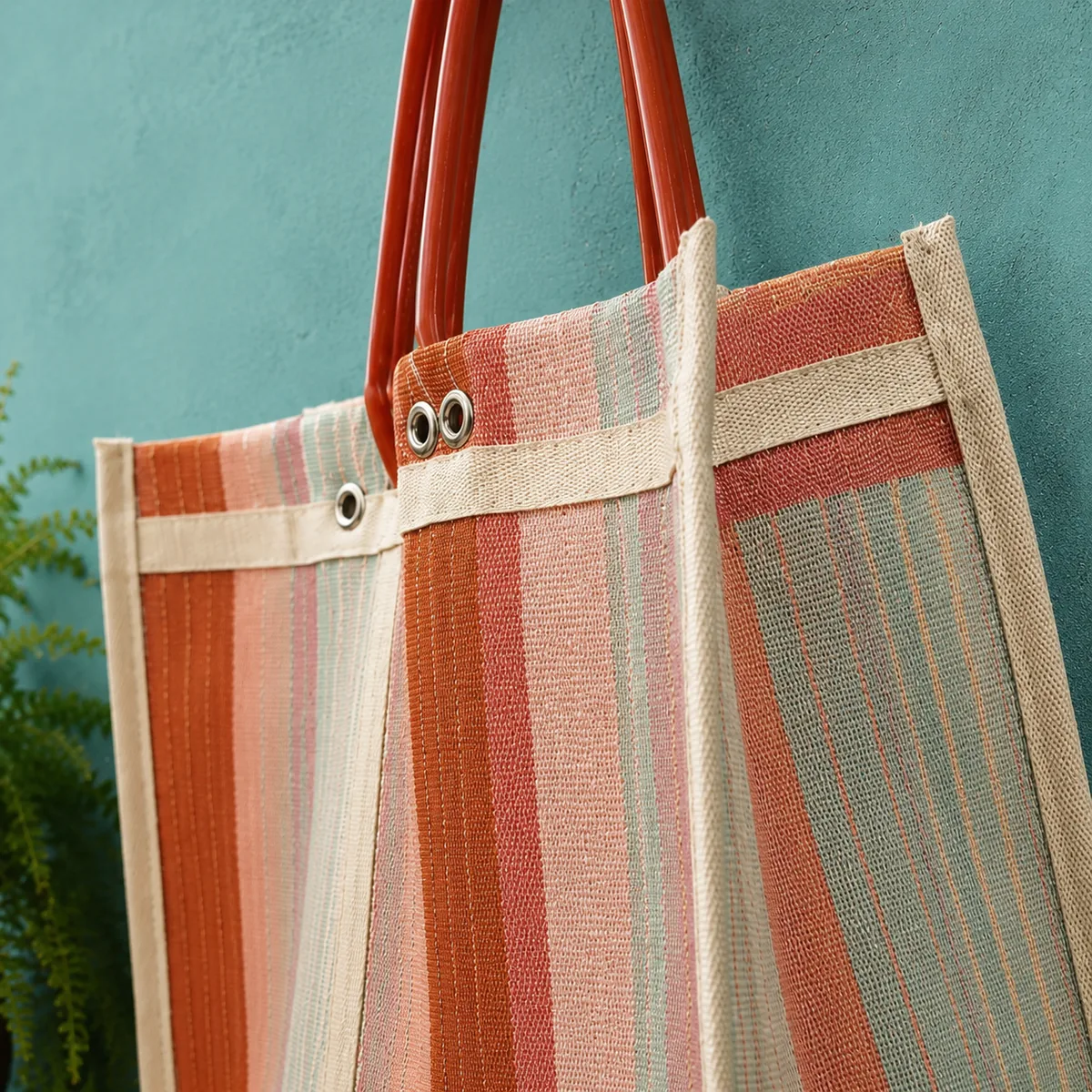
A bag begins as a roll of mesh. The artisans unspool it onto a long wooden table and cut it down into pliegos — broad sheets. From each sheet comes the cuerpo, the body of the bag, about a meter long, and the laterales, the side panels, around forty centimeters. Several are cut at once, as Eva explains: "para que no estemos bien rini" — so they are not constantly going back to the cutting table.
Then comes the cinta — the binding tape that hems the raw edge — and the vivo, a fine piping the machine folds into the mouth of the bag. The asas, the handles, go on last, fixed with a remache — a metal rivet driven through both layers so it will never pull free. "¿Por qué duran?" Don Raúl likes to ask. "Diría mi mamá: hasta que se acaban." They last until they are finished. Not a day less.
Each costurera turns out roughly two hundred bags in a day. They go out of the workshop bundled by color, five tones to a pack, sold por docena — by the dozen, or by encenadas, as the workshop calls a longer string. They travel to wholesalers across Mexico — one shipment is loaded today for a friend in Arcelia, Guerrero — and from there to Europe, to Australia, to Japan. "Mis bolsas están en toda Europa," Don Raúl says. "Lo más lejos, Australia, Japón. Y yo me siento muy contento de ver mis productos en boca de todos, en manos de todos."
A simple bag in the 40 cm size sells for somewhere between 22 and 32 pesos at the workshop door — "Mira, 22, 24, 29, 32."
What the Cinta Is Made Of
Here is the part most people never see. The cinta and the asas — the binding tape and the handles — are not new material. They come to the workshop through a quiet network of recolectores who gather discarded plastics across the city and bring them in. "Hay mucha gente que se dedica a recolectar y me hacen el favor de traerlo," Don Raúl explains. "Yo se los compro y lo reciclo para hacer la cinta y las asas." The collected plastic is reprocessed and becomes the strap that holds a kilo of nopales on the way home.
"Nosotros generamos cultura," he says. "Nosotros no generamos basura. Nosotros reciclamos la basura."
In the last few years, sales have grown by roughly seventy percent. Some of that is laws written to protect the environment — the slow retreat of single-use plastic bags. Some of it is the world remembering that a market bag should be reusable. The workshop does not advertise. The bag advertises itself.
The Patterns They Print
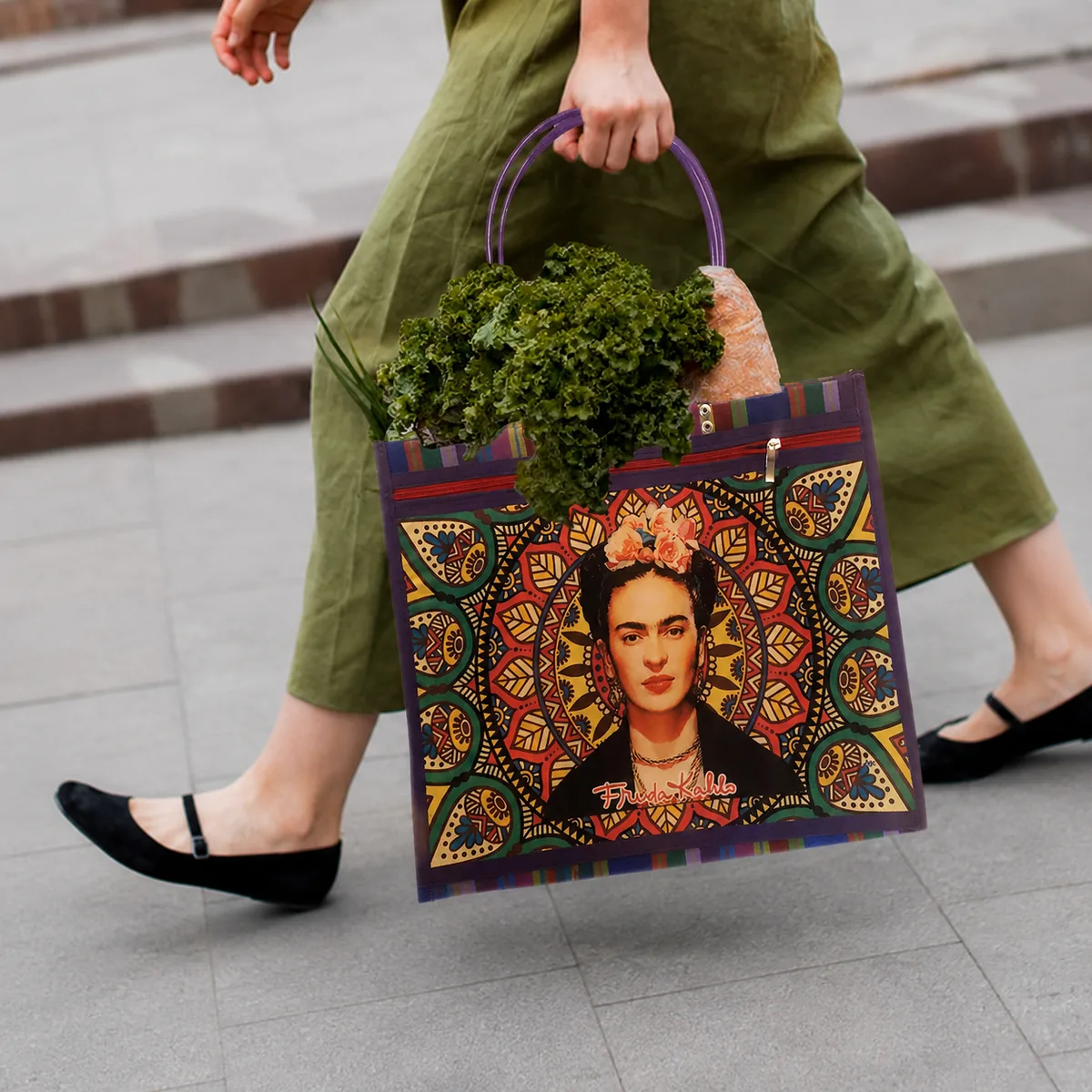
In one corner of the taller, a sublimation press pulls color into the mesh. The plain bag — la lisa — is the favorite. But the ones people ask for como pan caliente are the ones that carry Mexican faces: Frida Kahlo, the Morenita del Tepeyac, the figures of the Lotería deck, and the Leles — the Otomí rag dolls with their braided yarn hair.
A bag is a body. Whatever is printed on it, the woman who carries it carries through the city like a small flag. As one news segment that visited the workshop put it: "Sus colores son sinónimo de México. Sus texturas, su cotoneo al andar, las asas — todo eso y mucho más representan a México en día de Plaza."
A Cousin in the South
The phrase bolsa de mercado does not belong only to the mesh tradition. Down in Chiapas, in San Cristóbal de las Casas, there is another bolsa that shares the name and almost nothing else. It is made of manta — soft cotton muslin — and it is hand-embroidered by women artisans from San Juan Chamula with what they call bordados de honguitos, little mushroom stitches that bloom across the cloth in dense, slow color. "El origen de mi bolsa artesanal es de manta," one Chiapas host explains. "Tiene bordados a mano, los famosos bordados de honguitos, realizados por mujeres artesanas de San Juan Chamula."
Different craft. Different hands. Different mountains. But the same instinct — that the thing a woman carries to market should be made by someone who loves the work. The mesh of Roldán and the manta of Chamula are cousins under one name, and that is part of what is beautiful about Mexico: a single word, bolsa, holding two whole worlds inside it.
Si yo me muriera y volviera a nacer, me llamaría Raúl, y haría bolsas.
— Don Raúl, asked once what he wanted to be in the next life.
The Timeline of a Bolsa de Mandado
| Step |
What Happens |
Pace |
| 1. Receive malla |
A bolt of mesh fiber arrives at the taller |
— |
| 2. Cut pliegos |
Broad sheets are cut from the bolt |
Batched, several at a time |
| 3. Cut cuerpo |
The body panel — about 1 meter long |
Seconds per bag |
| 4. Cut laterales |
Two side panels, around 40 cm each |
Seconds per bag |
| 5. Sew cinta and vivo |
Binding tape and piping finish the edge |
Stitched at the machine |
| 6. Attach asas with remache |
Recycled handles riveted in place |
The bag becomes a bag |
| 7. Sublimation print (optional) |
Frida, Morenita, Lotería, Lele transferred onto mesh |
One press at a time |
| 8. Bundle by color |
Five colors to a pack, sold por docena |
~200 bags per costurera per day |
| 9. Ship |
To Mexican wholesalers, and onward to Europe, Australia, Japan |
~30,000 bags every 15–20 days |
Sources: Azteca Noticias, "¿Cómo se fabrican las bolsas de mandado que ahora replican en todo el mundo?"; México a colores, "La bolsa asiática que NO es artesanal".