The Patience in a Single Bead: Inside Huichol Art
In the highlands where five states meet, Wixarika hands press glass beads into warm wax to transcribe a cosmovision — one grain at a time.
In the highlands where Jalisco, Nayarit, San Luis Potosi, Zacatecas, and Durango meet, a people who call themselves Wixaritari — the Spanish-speaking world knows them as huicholes — have been pressing tiny glass beads into warm wax for longer than anyone living can remember. The work is small. On a good day, countless grains of glass will be set, one by one, into a surface no wider than a palm, forming a deer, a sun, a spiral that looks like something remembered rather than invented.
This is arte Huichol. A meticulous fine style, as one artisan in Mexico City put it — un estilo minucioso fino. And it begins, always, with something soft enough to hold a bead.
How the Bead Meets the Wax
The substrate is cera — wax, warmed by hand until it gives. You press it into the grain of a wooden figure, a gourd, a mask. You work it with your thumb until it takes the shape of what lies beneath. Then, one at a time, you lift a bead and set it. Then another. Then another.
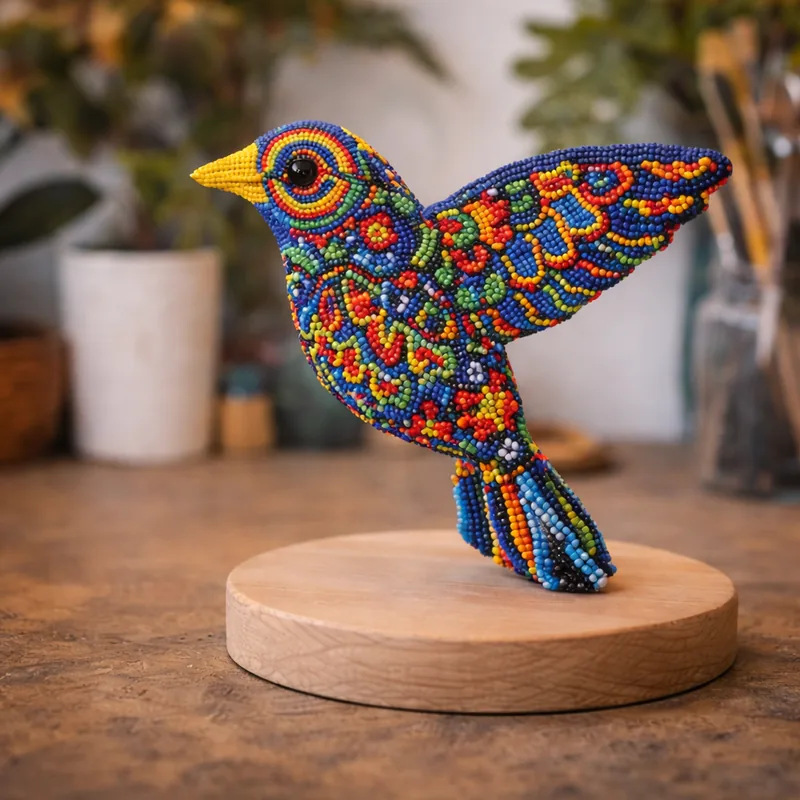
The wax holds. That is the whole secret and none of it. A medium as old as beekeeping, pressed against glass beads that catch light like water, on a form carved from wood or dried from a gourd — and suddenly a venado stands there, or a flowering vine, or the face of something older.
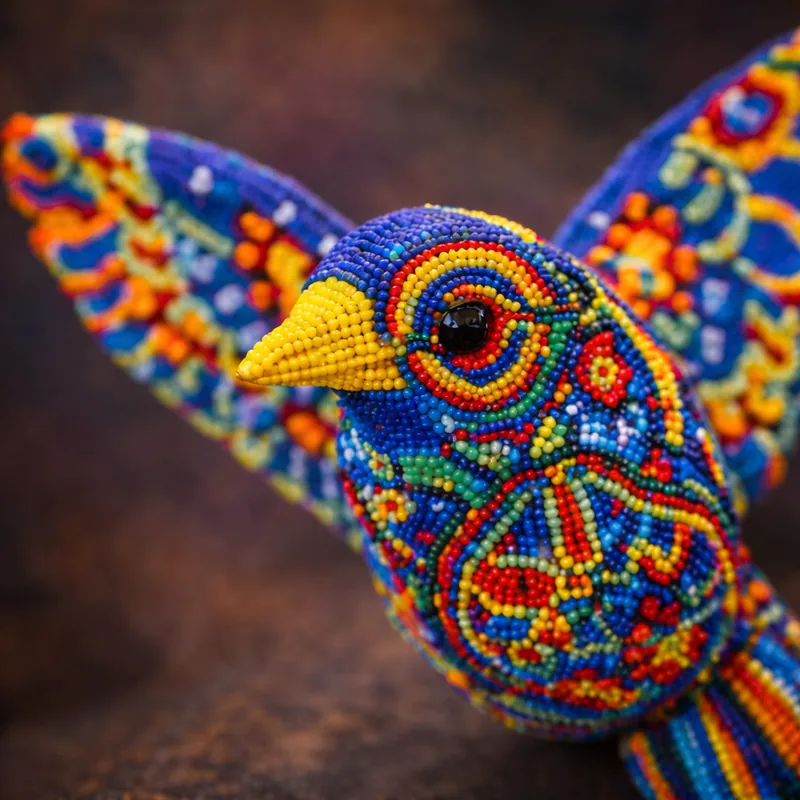
What looks like decoration is arithmetic done by the hand: how many beads across the shoulder, how the color shifts as the figure turns, where the line of one row meets the next without a break. Enlaza y fija con destreza la chaquira — the beads are interlaced and fixed with skill until harmonious figures form.
Yarn Before Beads
The craft has more than one language. There are cuadros de hilo — yarn pictures, waxed strands pressed into a board — and there is the beadwork that grows across gourds and carved wood. Hilario, a Wixarika artisan who came from San Andres in Jalisco to Mexico City as a boy, learned the sequence firsthand alongside a friend and his father in the Plaza de la Ciudadela.
"Empece sencillo sencillo, y ya despues entre pegando la chaquira," he told MILENIO — I started simple, simple, and only later moved to applying the bead.
Yarn first. Then glass. The hand learns on one what it will later repeat in the other: how a line curves, how a field of color fills without crowding, how symmetry finds its own center.
Look closely at any piece — a jicarita, the small gourd bowl that holds only a few beads set in wax as ceremonial offering; or a wooden animal entirely scaled in chaquira; or even a car, whose surfaces this style has been applied to, bead by bead. The symmetry is unmistakable. Left mirrors right. The pattern turns on its own axis.
This is not a stylistic preference. It is a memory.
The symmetrical forms come from how the ancestors perceived the world during ceremony, with peyote — parte esencial of the ritual — opening a particular way of seeing. What the eye received there, the hand later repeats. The figures on a bowl are not invented. They are transcribed.
The venado, the deer, is central to this cosmology. Les ensena el camino que deben seguir — the deer shows the path they must follow. So the deer is placed carefully, facing the way a guide would face.
Before any of this became something a traveler could buy in the Plaza de la Ciudadela in Mexico City, the figures existed for one reason. "Solo hacia figuras exclusivamente para las ceremonias, era una ofrenda," Hilario said — we only made figures for the ceremonies; they were an offering.
The small jicaritas with their few beads in wax were for the ceremony. The monos, small figures shaped with cera and bead, were for the ceremony. The yarn pictures, in their earliest form, held the image of what had been seen so that it could be given back.
Four places anchor this giving, distributed across Jalisco, Nayarit, Durango, and San Luis Potosi. One is where, in the telling, fire was born. Another, in San Luis Potosi, is where the sun was born and the world came forth. The geography is not a map to be traveled quickly — it is a circuit, and the art is one of its traces.
El fuego es para nosotros muy importante, es nuestro abuelo. — Fire is very important to us; it is our grandfather. Kin, not element.
What Travels With the Craft
The same hands that press beads also draw a bow across a violin. Wixarika ceremonial music and Wixarika beadwork are not separate disciplines — they are two expressions of one life. Hilario's own violins attest to it: he continues to play traditional music, and is called upon when a ceremony requires it. Nunca se me olvida — it is never forgotten. The bead and the bow belong to the same hand.
A Wixarika speaker put the invitation plainly to NotimexTV: many people know the tradition only by its bright dress, por el colorido, por el simbolismo. If you find that beautiful, he said, come know the culture — lo inmaterial. Es todavia mucho mas bonito, es todavia mucho mas profundo. Still more beautiful. Still more deep.
The bead is the doorway. The wax is the threshold. What stands behind them is a cosmovision that has been carried, in the patience of fingers, from the Sierra to a market stall in the capital and back again — an inheritance kept not by writing it down, but by pressing it, one grain at a time, into something warm enough to hold.
Es conservar, cuidar nuestra tradicion, nuestro territorio. — To conserve, to care for our tradition, our territory.
The Shaping of a Beaded Jicarita
| Stage |
What Happens |
| 1. Preparing the gourd |
A small gourd (jicarita) is dried, hollowed, and its inner surface cleaned and smoothed. |
| 2. Warming the wax |
Cera is warmed by hand until pliable, then pressed into the gourd's inner wall in a thin, even layer. |
| 3. Composing the design |
The artisan holds the pattern in mind — drawn from ceremony, inherited, or shaped within tradition. Axes of symmetry are fixed before the first bead lands. |
| 4. Setting the first beads |
Individual chaquiras are lifted one by one and set into the wax. Central motifs — often the venado, sun, or flower — are placed first. |
| 5. Filling the field |
Surrounding color fields are laid row by row, following the symmetry of the central figure. |
| 6. Finishing the rim |
The edge is completed with a contrasting band, sealing the composition. |
| 7. Offering or sale |
Historically, the finished piece entered a ceremony as ofrenda. Today, many pieces are also made for sale; the ceremonial pieces remain distinct. |
Sources: "Descubre el fascinante mundo del arte Huichol y su significado" (MILENIO); "La lucha huichol por mantener su identidad" (NotimexTV); "Huichol Musical — Bailen Huichol" (Latin Power Music).