The Craft of the Mexican Pinata
From engrudo to siete picos — how Acolman's seven-pointed star is built to be broken.
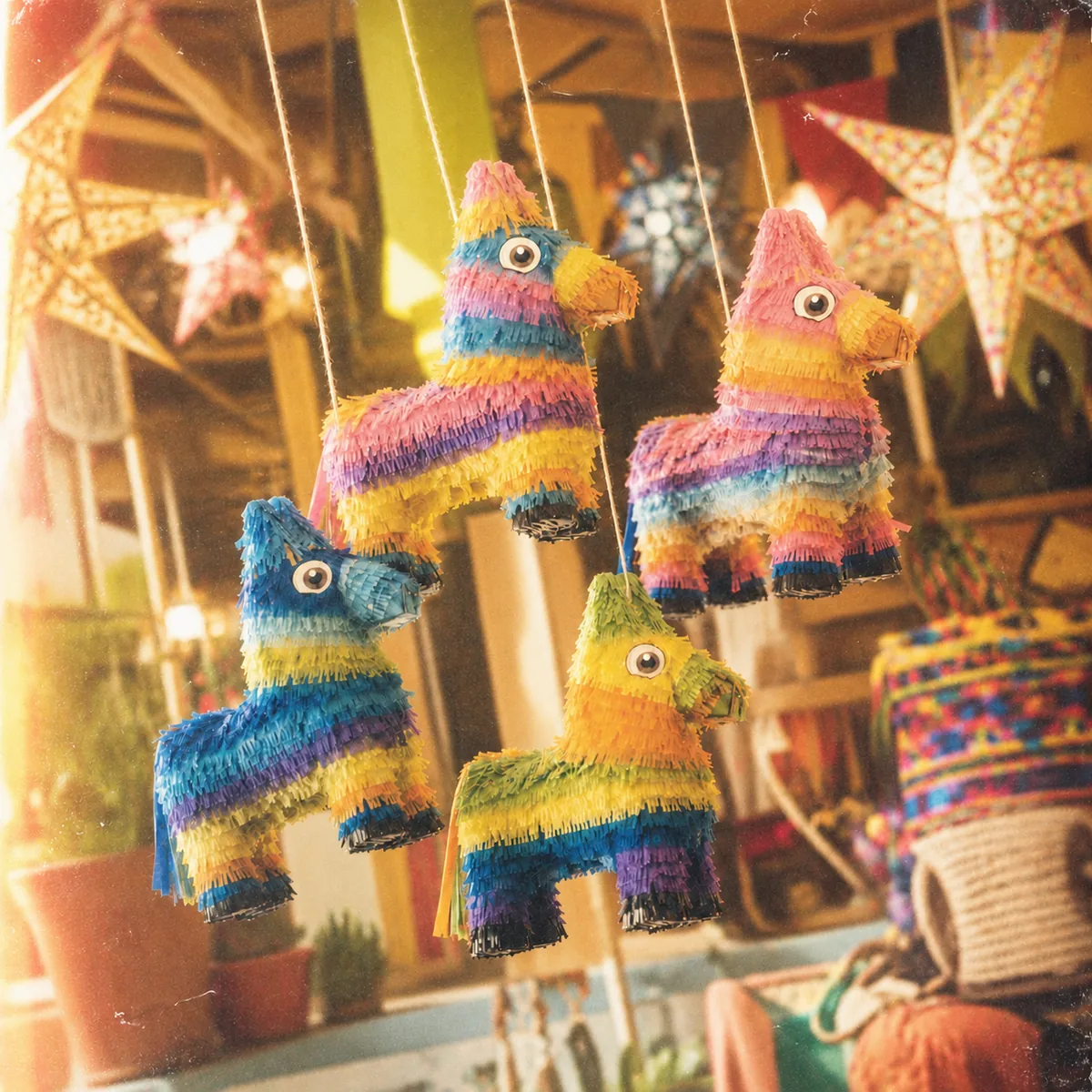
You build it knowing it will be destroyed. That is the first thing to understand about making a pinata. Every layer of paste, every cone shaped by hand, every strip of colored paper smoothed into place — all of it leads to one moment: a blindfolded child swinging a stick, and everything you made splitting open to release its hidden sweetness.
This is not tragedy. It is the whole point.
Long before the Spanish arrived, the Aztecs practiced something remarkably similar during the winter solstice festival of Panquetzaliztli, celebrating the birth of the war god Huitzilopochtli. They sculpted a figure from salt, toasted corn flour, ground seeds, and miel de maguey — agave honey — then adorned it with four hundred bone-shaped ornaments. When the figure was broken, it was not destruction. It was consecration. The fragments became sacred, shared among the community.
Centuries later, in 1586, the friar Diego de Soria at the convent of San Agustin de Acolman received authorization from Pope Sixtus V to hold misas de aguinaldo — gift masses during the days before Christmas. Those masses grew into what we now call posadas, and the pinata traveled with them, absorbing Chinese, Italian, and Spanish influences along the way. The ancient logic survived: you break what is beautiful to receive what is blessed.
Today, Acolman remains the epicenter of pinata-making in Mexico, celebrated each December with the Feria de la Pinata.
Getting the Paste Right
Everything begins with engrudo — a simple wheat-flour paste that behaves like the craft itself: humble ingredients, careful attention, remarkable strength.
You start with about five hundred milliliters of water and a hundred sixty milliliters of flour. Dissolve the flour in cold water first. This matters — if the water is warm, the flour clumps and the paste is ruined before it starts.
Then you heat it slowly, fuego lento, stirring constantly until it thickens into something smooth and glossy, like a thin bechamel. When it coats the back of your spoon evenly, it is ready.
This paste is the invisible architecture of the entire pinata. Every other material depends on it.
Building the Shell
The base starts with a simple inflated balloon — or, for those who learned the old way, a molde de barro, a clay mold that produces a harder, more uniform shell.
You tear paper into pieces and begin layering them over the form with a brocha — a wide brush — alternating horizontal and vertical strips so the fibers cross and lock together. Three layers for a small party pinata. Eight for one that needs to survive being hoisted on a rope and struck repeatedly by enthusiastic guests.
Then you wait. A day, sometimes two, while the shell dries and hardens. If you are drying in the sun, you check every thirty minutes — the air inside the balloon expands in the heat and can burst through your careful layers if you are not paying attention. You rotate it. You watch.
When the shell is solid, you pop the balloon, open the boquilla — the mouth — and punch two small holes for the lazo or cuerda — the rope or cord — that will suspend it. Thread, knot, and the hollow body is ready for its transformation.
Shaping the Seven Points
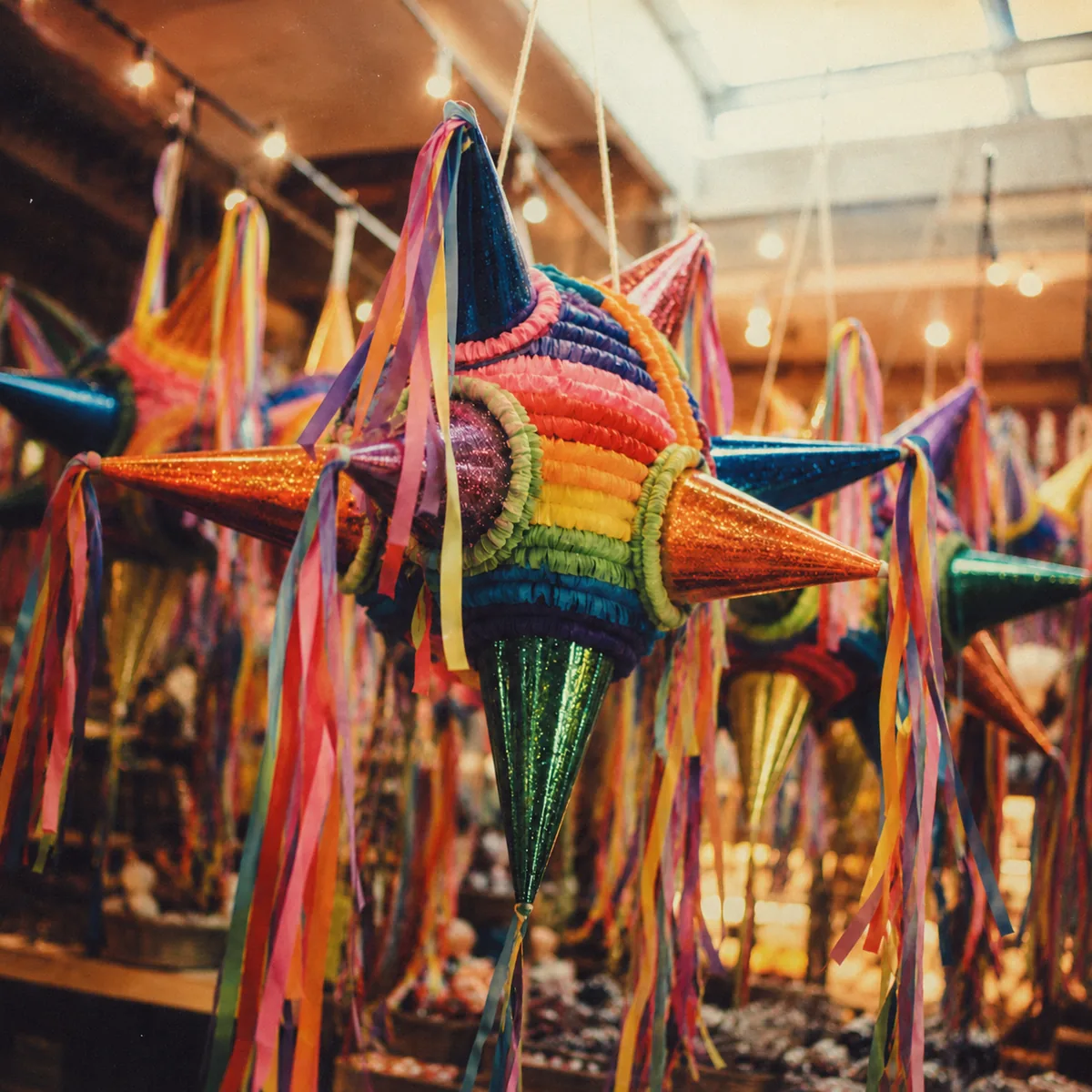
The star shape that most people picture when they hear "pinata" is the pinata de siete picos — seven cones radiating from the sphere. Each cone is rolled from cartulina or caple — heavy card stock — fixed with tape or a staple, and trimmed at the base so it sits flush against the round shell.
The first cone serves as the molde for all the others, so they come out uniform. Five cones form the points of a star. The remaining two fill the gaps. You attach them with glue or staples, then paper over the joints for strength.
The geometry is simple. Getting every cone even, tight, and properly anchored is not.
Dressing It in Color
Now comes the part that makes a pinata a pinata: the paper.
Papel de china — tissue paper — is the traditional choice. You cut it into strips about eight centimeters wide, fold them, and snip along the folded edge to create barbitas — tiny fringed whiskers that will ripple and shimmer when the finished pinata moves in the air.
You work from the tip of each cone downward, layering strip over strip so the fringe cascades like feathers. Ten full pliegos — sheets — of tissue paper just for the base sphere alone.
Some artisans work instead with papel metalico — metallic paper — cutting and curling it into tiny monitos — bows — that catch the light. This method is far more labor-intensive, but the result glitters.
The final touch: long trailing strips — tiras colgantes or barbas — at the tip of each cone, curled and glued last. They are the pinata's final gesture of extravagance before it meets its end.
The Timeline of a Pinata
| Step |
What Happens |
Duration |
| Engrudo |
Flour dissolved in cold water, heated slowly until smooth |
15–20 min |
| Layering |
Paper strips applied over balloon or clay mold, 3–8 layers |
1–2 hours |
| Drying |
Shell hardens; rotate every 30 min if sun-drying |
1–2 days |
| Opening |
Pop balloon, cut boquilla, punch 2 holes, thread rope |
15 min |
| Cones |
Roll, trim, and attach 7 card-stock cones to shell |
30–45 min |
| Decorating |
Cut, fringe, and layer tissue paper strips over entire form |
2–3 hours |
| Finishing |
Add trailing streamers, fill with fruit and candy |
15–20 min |
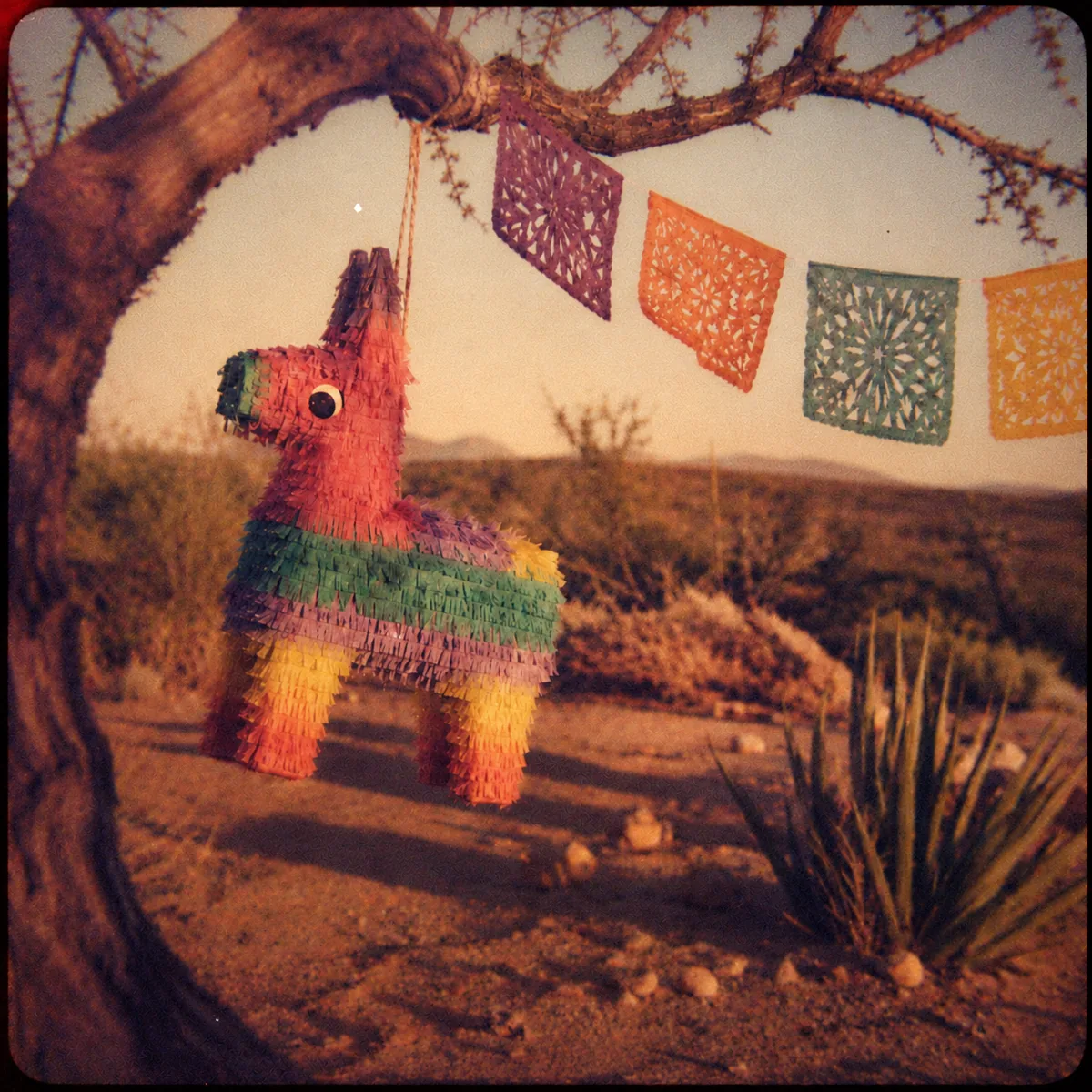
What you hold at the end is two to three days of patient, repetitive handwork wrapped in color and filled with sweetness. It will hang from a rope in a courtyard or a street, spinning slowly, beautiful and temporary. Someone will put on a blindfold. Someone will hand them a stick. And when the shell finally cracks and the contents rain down, the craft will have done exactly what it was always meant to do — transform itself, through breaking, into something shared.
Sources: "La pinata, sera una tradicion mexicana?" (Veka Duncan); "Asi fabrican las pinatas en Acolman" (Top Curiosidades); "Como hacer una PINATA paso a paso" (savinarte); "Como hacer una PINATA paso a paso" (Angellin Rubio).