Tenango, in the Place of the Walls
How tenango embroidery was born in rural Hidalgo
In a small village in the highlands of Hidalgo, a young woman sat down with a needle and a piece of cloth in the 1950s. She had no pattern to follow, no teacher to guide her. Her name was Josefina Jose Tavera, and she needed to make a living. What she created would eventually travel far beyond the misty slopes of the Sierra Madre Oriental, appearing in international markets, sparking legal battles with global fashion houses, and becoming one of the most distinctive forms of Mexican textile art.
The embroidery tradition she set in motion — known simply as tenango — is now recognized worldwide. But its history is surprisingly short, deeply personal, and tangled with questions about where creative inspiration truly comes from.
What Does Tenango Mean?
To understand tenango embroidery, you first have to understand the place that gave it its name. Tenango de Doria is a municipality in the state of Hidalgo, tucked into the Sierra Madre Oriental where the climate is temperate, humid, and rainy for most of the year. It borders San Bartolo Tutotepec, Huehuetla, and Metepec. The name itself is Nahuatl in origin — tenango means “in the place of the walls” or “a walled place,” a meaning still reflected in the municipal coat of arms, which depicts a wall topped with battlements.
Just 4.4 kilometers northeast of the municipal seat lies San Nicolas, the village where the story really begins. Ninety-eight percent of San Nicolas’s population is indigenous Otomi, and eighty-four percent still speak an indigenous language. This is not a place that modernization reached quickly or completely. In the middle of the twentieth century, it was even more isolated — a small community where economic opportunities were scarce.
Josefina’s Needle
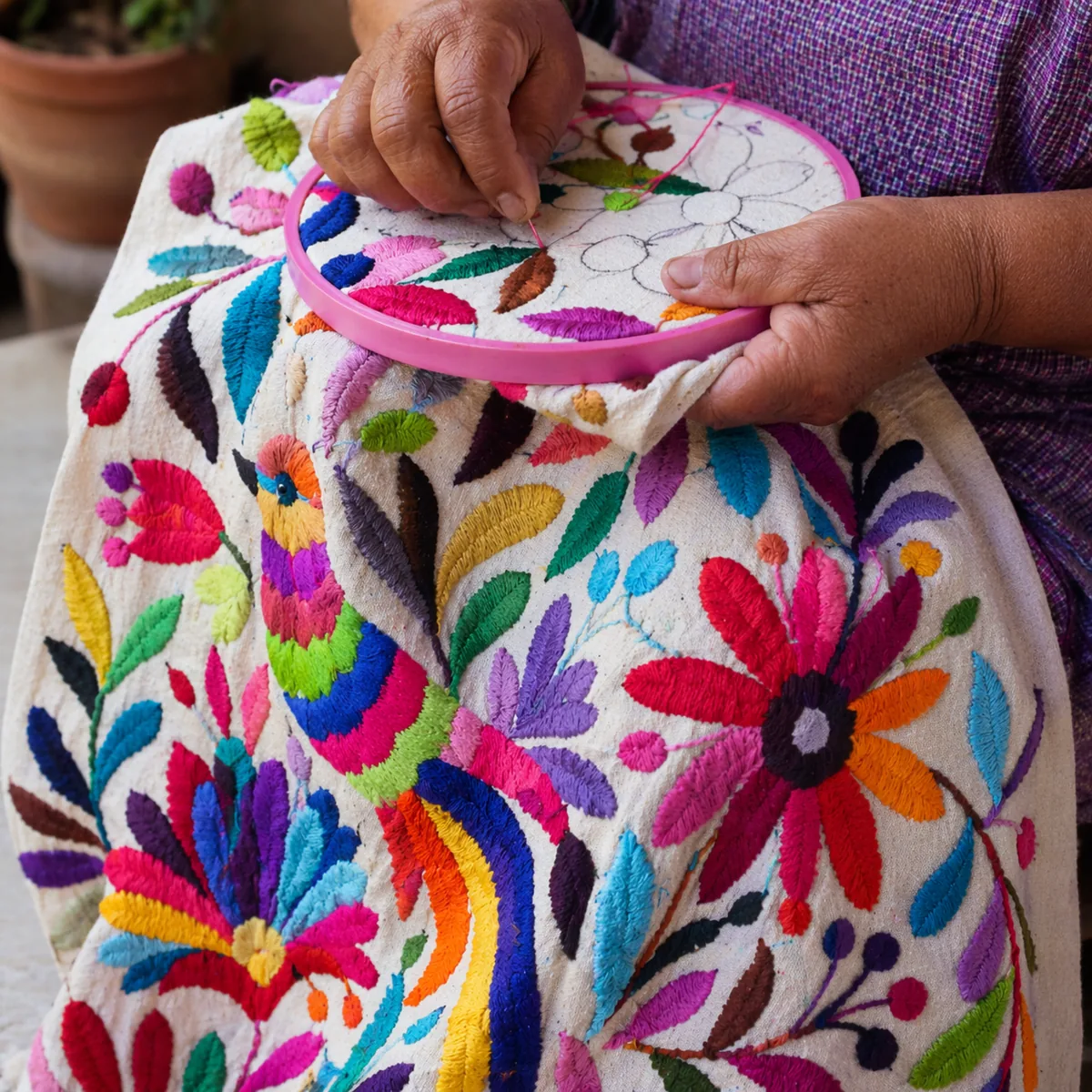
According to community accounts, Josefina Jose Tavera began embroidering designs onto cloth in the 1950s, working freehand without any traced patterns or molds. The earliest pieces used only black and red thread. They were functional objects: napkins and tablecloths, the kind of thing a household might use or a market vendor might sell. But the designs were striking — dense, flat compositions of animals, plants, and human figures that filled every corner of the fabric with a visual energy that was hard to ignore.
Her mother, Guadalupe Talavera Cristobal, carried one of the first finished pieces to the market in nearby Pahuatlan. The response was immediate. People wanted more. And with that first sale, a new artistic tradition had a market.
Josefina died in 2020 at the age of 87. By then, the art form she started had spread throughout San Nicolas and the surrounding communities, practiced by women who had learned from her example.
The Cave Paintings and the Question of Origins
There is a second origin story — one that does not contradict Josefina’s role but adds a deeper layer. Near San Nicolas, at a site called “El Sirio,” there are cave paintings — pinturas rupestres — depicting animals and human figures on rock surfaces. Some members of the community say that the earliest tenango embroiderers drew inspiration from these pre-Hispanic images, translating the forms they saw on stone into forms they could stitch on cloth.
The two narratives sit side by side without much tension. Josefina may well have been the first person to pick up a needle and create what we now call a tenango. And the visual vocabulary she used — the flat, profile-view animals, the way figures fill the entire surface without empty space — may echo forms that have existed in the region for centuries or longer. One story is about an individual act of creation. The other is about a communal visual memory that survived colonization and found a new medium.
Los bordados son los codices que la conquista no pudo borrar — the embroideries are the codices that the conquest could not erase.
What Is Tenango Embroidery?
For the first decades, the embroidery had no formal name. It was simply what the women of San Nicolas made. But as demand grew and pieces began circulating more widely, the community tied the art to its place of origin by calling it tenango, so that buyers could identify originals and distinguish them from imitations.
Over time, the craft evolved. The original palette of black and red gave way to vivid color combinations — greens, blues, oranges, and pinks that make contemporary tenangos instantly recognizable. The range of objects expanded too, from the original tablecloths and napkins to pillow covers, dresses, bookmarks, and wall hangings. The motifs grew to include the endemic wildlife of the Sierra — hummingbirds, armadillos, deer, squirrels, rabbits, foxes, badgers, donkeys, dogs, horses, roosters, owls, fish, cats, dragonflies, lizards, eagles, turkeys — as well as flowers, plants, trees, scenes from daily life, and pure imagination.
As one artisan explains: Plasmamos todo lo que viene de nuestra imaginacion porque esto es de la imaginacion. Los dibujos no son calcados, no hay moldes — We capture everything that comes from our imagination. The drawings are not traced. There are no molds.
Every piece is unique. That is not a marketing claim — it is a structural fact of the tradition.
The Weight of the Work
What is easy to admire from a distance is grueling up close. A single-color tablecloth measuring two meters by two meters takes four to five months of painstaking needlework. The compensation for that labor is approximately 3,000 Mexican pesos — as one artisan pointedly asks, what can you do with 3,000 pesos over the months it takes to complete a piece?
The physical toll is significant. Artisans describe back pain and deteriorating eyesight from months spent hunched over detailed, colorful stitching. Many clients do not value the work appropriately. As one embroiderer puts it: una artesania va hecha a mano y tiene muchisimo valor — a handcraft is made by hand and has immense value.
The community has taken concrete steps to protect itself. After a process that took fifteen years, the artisans obtained a collective trademark. In 2017, they achieved their first legal victory, using that trademark against plagiarism by the Spanish brand Mango. Legal action was also pursued in connection with designs used by Hermes and Carolina Herrera. Piracy remains widespread — hay mucha, mucha pirateria por todos lados — but the trademark means the community can now say: this is our tenango, and it is protected.
A Living Tradition
Tenango embroidery began in the 1950s. In the long timeline of Mexican textile arts, that makes it practically newborn. Yet it has already achieved a level of cultural significance that far older traditions might envy. It represents a symbol of identity, resistance, and Mexican cultural pride.
What makes the tenango story remarkable is not just the beauty of the work but the clarity of its origin. We know who started it, and roughly when. It was not an ancient practice handed down through millennia of unbroken tradition. It was created by a woman in a village where almost everyone was indigenous and most people spoke Otomi, using thread and imagination and whatever visual memory — personal or communal — she carried with her.
That a single act of resourcefulness in a highland village could produce an art form now recognized internationally says something worth remembering about where creativity comes from and who gets to be called an artist. Josefina Jose Tavera never held that title in any formal sense. But every tenango that exists is, in some way, a descendant of the first piece her mother carried to market in Pahuatlan.
Sources: El Universal Hidalgo, AJ+ Espanol, Tenangos Originales, Canal Catorce