Papel Picado, Cut from Air
The ancient art of papel picado in the town of twisted thorns
There is a sound you would not expect to hear in a paper workshop. Not the whisper of scissors, not the hush of folding — but the sharp, rhythmic crack of a hammer striking steel. Again and again, steady as a heartbeat. In the town of Huixcolotla, in the state of Puebla, artisans do not cut paper. They chisel it. And the paper, fifty sheets deep, obeys.
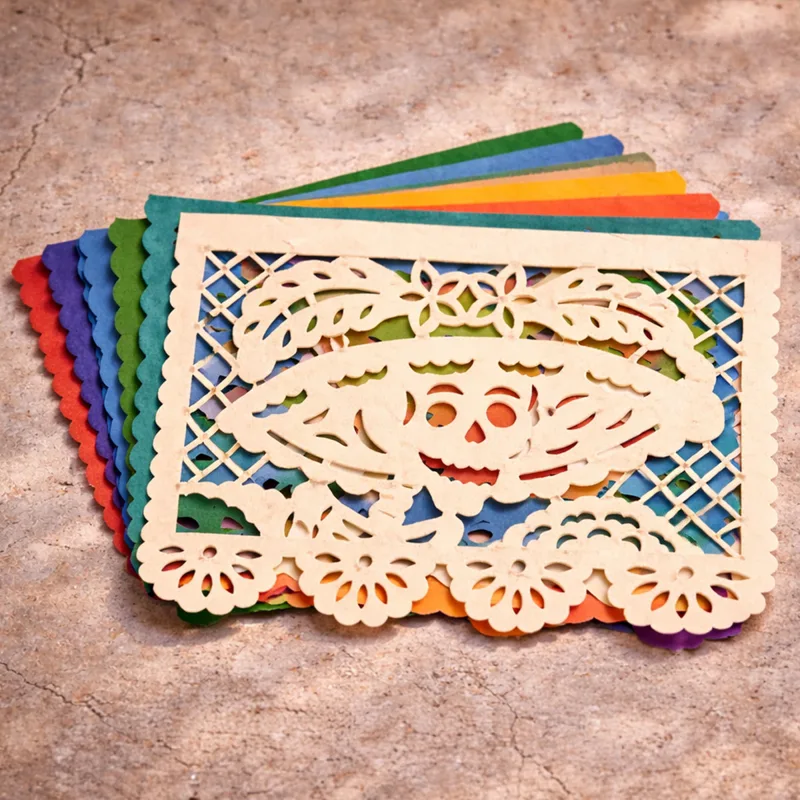
This is papel picado — literally, “perforated paper” — one of Mexico’s most visually arresting and least understood crafts. You have probably seen it without knowing its name: those luminous banners of tissue paper strung across streets and plazas, swaying in the wind, their intricate silhouettes casting lace-like shadows on the ground below. They appear at weddings, baptisms, quinceañeras, Independence Day, and above all at Día de Muertos, when the living decorate for the dead. But what looks delicate enough to dissolve in the rain is, in fact, born from hammer blows on a slab of lead.
Papel picado is tissue paper chiseled, fifty sheets at a time, into lace-like banners that Mexico hangs for its celebrations. At Día de Muertos those banners turn pink, orange and purple, and they hang over streets and altars as the living make ready for their dead.
Where Does Papel Picado Come From?
Long before tissue paper arrived in Mexico, the Aztecs were already making something remarkably similar. They produced amatl — a bark paper pounded from the inner cortex of wild mulberry and fig trees — and used it to create banners and ornamental panels that decorated temples, streets, houses, and agricultural fields. During the calendar month of Atlacahualo, meaning “the scarcity of water,” communities mounted bark-paper banners on wooden posts to honor the rain deities Chalchiuhtlicue and Tlaloc. During Panquetzaliztli — “the raising of the banners” — celebrations marking the birth of the war god Huitzilopochtli at the winter solstice filled public spaces with paper effigies and figures sculpted from amaranth seeds for the fire god Xiuhtecuhtli.
The Spanish conquest disrupted this tradition but did not destroy it. Over the centuries, papel de china — the thin tissue paper that Chinese trade routes eventually delivered to workers through the tiendas de las haciendas — replaced bark paper as the medium. The tools changed. The impulse did not. By the 1930s, the craft had taken firm root in Puebla, and by the 1960s and 70s it had spread to Mexico City, where workshops in Xochimilco continue the practice today. In 1998, the government of Puebla declared papel picado part of the state’s cultural patrimony.
The name of the town where this tradition runs deepest tells you something about the land itself. Huixcolotla comes from Nahuatl: huitzli (thorn), colotl (twisted or hooked), and tla (place). The place where twisted thorns abound. It is a fitting origin for an art form that finds beauty in sharp edges.
How Is Papel Picado Made?
To watch an artisan begin a piece of papel picado is to witness a strange contradiction: heaviness in service of weightlessness.
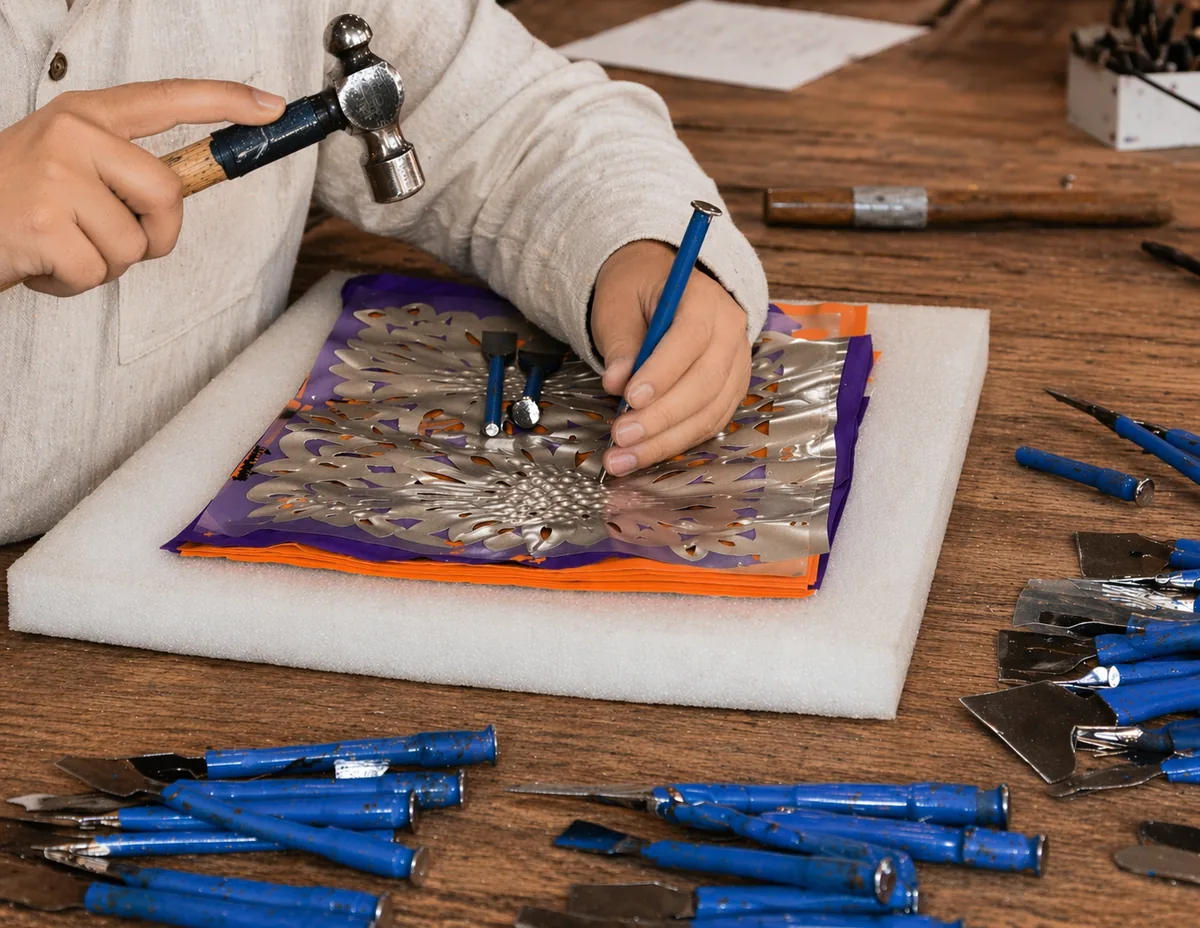
The process unfolds in three stages, each with its own Spanish name: diseño, picado, and pegado — design, chiseling, and assembly. First, the artisan stacks between fifty and one hundred sheets of tissue paper and nails them together so they will not shift. An original drawing is placed on top as a guide. Then the stack is laid on a planchuela de plomo — a lead plate whose softness is not incidental but essential. Lead yields just enough under the chisel’s blade to allow clean cuts through every layer simultaneously, without tearing or dragging the paper.
The chisels themselves — cinceles — are the artisan’s true vocabulary. A full working set numbers over two hundred pieces, each ground to a different profile. There are media cañas, half-round blades for curves. Sacabocados for punching clean circles. Puñetas and cuadras for straight edges and corners. Each one is held in position, struck with a hammer, and moved to the next cut. The sound fills the workshop: tap, tap, tap, tap — precise, unhurried, meditative. This step, the calada, takes anywhere from twenty to thirty minutes for a traditional Día de Muertos motif to five hours for a complex commissioned design. A standard piece on a medio pliego — a half-sheet — demands one to two hours of an artisan’s focused attention.
When the chiseling is done and the nails are pulled, fifty identical silhouettes separate from the stack like pages of a secret suddenly revealed. Each one is whole, intricate, and impossibly thin.
What Do the Colors of Papel Picado Mean?
The finished sheets are sorted by color and strung onto hilos de algodón — cotton threads — or sewn onto a reinforcing strip called rápido, forming the long banners that will eventually span a street or drape across an altar.
The colors are not arbitrary. They carry centuries of layered meaning, Catholic and pre-Columbian intertwined. Blue, pink, and white honor the Virgen Maria. Yellow and white mark patron saint festivals. Red, white, and green — the flag’s colors — belong to the Virgen de Guadalupe and Independence Day. A rainbow palette signals Christmas. For Día de Muertos, the palette shifts to pink, orange, and purple; purple alone marks Pascua, the Easter season.
Beneath the Catholic symbolism, older Aztec color codes still echo. Orange once signified mourning. Purple spoke of royalty. Blue was reserved for those who had died by water. Red honored warriors and women who died in childbirth. Green was for the young, yellow for the elderly, white for children. Black belonged to the underworld and was never used in celebration.
To string a banner of papel picado, then, is to compose a sentence in color — a statement about who is being honored, what season it is, and which layer of Mexico’s history is speaking.
Breath, and the Letting Go
There is a philosophical dimension to papel picado that separates it from crafts made to endure. A clay pot survives centuries. A woven textile can outlast the hands that made it. But papel picado is fragile by design. It is meant to hang in open air, to catch the wind, to fade in sunlight, and eventually to tear and dissolve. This is not a flaw in the material. It is the point.
As one artisan describes it: paper is wind, breath, life itself. “Lo respiramos y exhalamos, es la presencia universal... pero no lo podemos atrapar por siempre.” We breathe it in and exhale it. It is the universal presence — but we cannot hold it forever. Each banner is a meditation on the fleeting nature of what we love, hung precisely at the moments when we gather to celebrate what matters most.
And yet within that ephemerality, something permanent persists. The artisans of Huixcolotla say that each craftsperson’s work is as recognizable as a fingerprint — una huella digital. Despite using the same chisels, the same lead plates, the same tissue paper, no two artisans produce identical cuts. The pressure of the hammer, the angle of approach, the rhythm of the hand — these cannot be standardized. “La persona es mejor que una máquina,” they say simply. The person is better than a machine.
Lo respiramos y exhalamos, es la presencia universal... pero no lo podemos atrapar por siempre — We breathe it in and exhale it. It is the universal presence — but we cannot hold it forever.
The next time you see a street draped in papel picado — sheets of colored tissue trembling in the breeze, their cut silhouettes casting intricate shadows on the pavement — know that each one began as a hammer strike on lead, repeated a thousand times by a hand that could not be replaced by any other. And know that it was made to be beautiful, and to let go.
Cut Paper Now
The language of cut paper did not stay with tissue. Today it also travels into amate, Mexico's bark paper, where openings and bridges are drawn into a sturdier, fibrous sheet made for a wall rather than the wind. Our Café Calado collection takes its name from the same word as the calada. Each design begins as a hand-cut paper study and is then laser-cut into Café amate at a small family-run studio, so the design holds while every sheet keeps its own fibres, tones and edges.
Sources: Tradiciones y costumbres de Mexico, El Universal, MILENIO, Yolo Camotes, Pavelinho Productions